
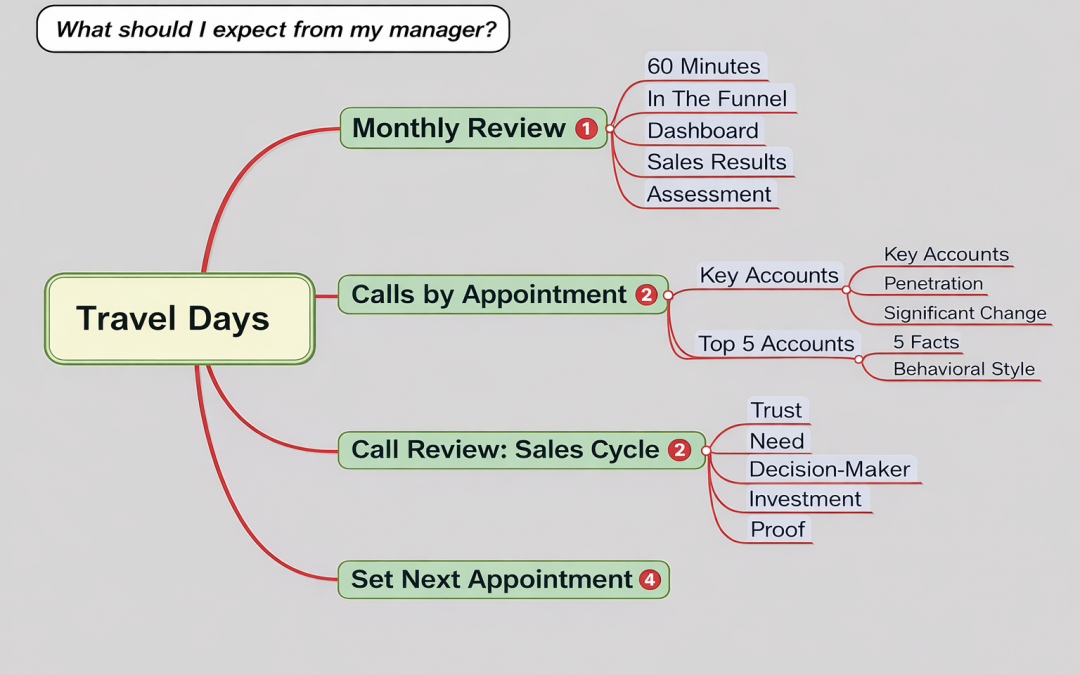
Throughout this AI-Enabled Sales Management series, we’ve examined AI tools that help maintain analytical focus on key performance indicators (KPIs). These tools help ensure alignment between representatives and management. Additionally, a critical component of this alignment is the monthly Travel Day—a non-negotiable requirement for effective sales leadership. Outside sales representatives (OSRs) must know exactly what their sales managers expect from travel days.
The requirement
Every sales manager should spend at least one day a month in the field with each OSR. When a manager cannot devote one day a month to an OSR, I have found that success becomes unlikely. Moreover, a manager’s time spent with a rep is essential for building trust, providing coaching, and understanding the real-world challenges each rep faces.
The Four Essential Components
There are four essential components to the Travel Day requirement.
- Monthly Review (30 Minutes) – Begin each Travel Day with a focused review of AI-enabled KPIs, including In-the-Funnel prospects, Dashboard metrics, and Sales Results. This review is an efficient and valuable way to set the tone for the day’s activities.
- Calls by Appointment – The OSR schedules appointments with both key accounts and prospects. Key account calls should address issue resolution, penetration opportunities, or significant account changes. For prospect appointments, the OSR must demonstrate knowledge of decision-makers, including their DISC profile type. Dominance (D), Influence (I), Steadiness (S), and Conscientiousness (C). This demonstrates preparation and strategic thinking.
- Call Reviews – Following each appointment, review the OSR’s performance using the AI agentic call report framework. The representative should provide evidence of their position in the sales cycle. Is it in building trust, establishing need, interacting with decision-makers, addressing investment concerns, or proving product value? Immediate feedback like this accelerates skill development.
- Set Next Appointment – Before concluding each meeting, schedule the next Travel Day. This commitment ensures continuity and accountability, preventing the all-too-common excuse that field time “just didn’t happen this month.”
Travel Days Matter
Travel Days transform the manager-representative relationship from one of supervision to one of collaboration. Also, managers gain firsthand understanding of market conditions, customer challenges, and competitive pressures. Representatives receive real-time coaching, validation of their approach, and support in navigating complex sales situations.
In my 50+ years of sales management experience, I’ve consistently observed that organizations with disciplined Travel Day practices outperform those that treat field time as optional. Also, AI tools make preparation for Travel Days more efficient, but do not replace the human connection, observation, and coaching that only face-to-face interaction provides.
Lastly, make monthly Travel Days non-negotiable in your sales organization—your team’s success depends on it.
Get tips and tricks like the above in The Art of Sales books. Or subscribe to the FREE monthly articles here.